

TEST
SOLUTIONS
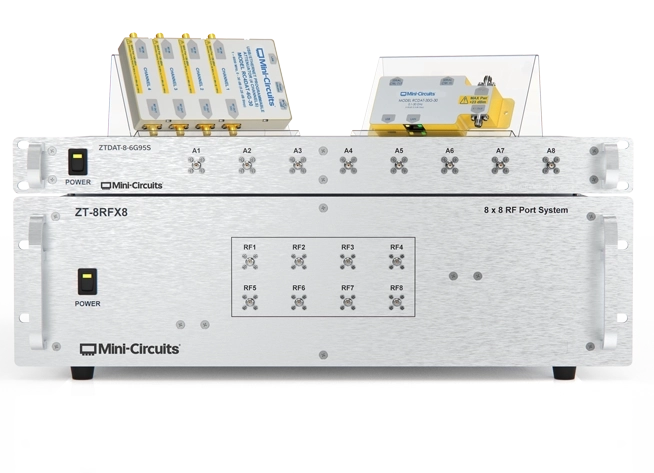
Mini-Circuits’ programmable attenuator product line provides versatile solutions for automating signal level control, simulating the effects of signal fading and a number of other useful functions. Our programmable attenuators offer outstanding accuracy, even at the highest attenuation settings and wide frequency ranges up to 67 GHz. These devices may be used individually or integrated into multi-channel systems for higher-volume setups.
Best viewed on desktop.
Please use the below filters to narrow down your search according to your required parameters.
You may also sort each column (alphabetic or numeric) by clicking on their header.
Please use the below filters to narrow down your search according to your required parameters.
You may also sort each column (alphabetic or numeric) by clicking on their header.
| Model Name | F Low | F High | # Channels | Max Attenuation (dB) | Rack Height | Connector Type | Connector Panel |
|---|---|---|---|---|---|---|---|
| Model Name | F Low | F High | # Channels | Max Attenuation (dB) | Rack Height | Connector Type | Connector Panel |
| ZTDAT-4-13G60S | 10 | 13,000 | 4 | 60 | 1U | SMA | Front |
| ZTDAT-4-13G90S | 10 | 13,000 | 4 | 90 | 1U | SMA | Front |
| ZTDAT-8-13G60S | 10 | 13,000 | 8 | 60 | 2U | SMA | Front |
| ZTDAT-8-13G90S | 10 | 13,000 | 8 | 90 | 2U | SMA | Front |
| ZTDAT-8-6G30S | 1 | 6,000 | 8 | 30 | 1U | SMA | Front & Rear |
| ZTDAT-8-6G63SR | 1 | 6,000 | 8 | 63 | 1U | SMA | Rear |
| ZTDAT-8-44G63K | 100 | 43,500 | 8 | 63 | 2U | 2.92 mm | Front |
| ZTDAT-12-6G30S | 1 | 6,000 | 12 | 30 | 1U | SMA | Front & Rear |
| ZTDAT-16-6G63S | 1 | 6,000 | 16 | 63 | 1U | SMA | Front & Rear |
| ZTDAT-16-6G9543 | 1 | 6,000 | 16 | 95 | 2U | 4.3-10 | Front & Rear |
| ZTDAT-16-6G95N | 1 | 6,000 | 16 | 95 | 2U | N-Type | Front & Rear |
| ZTDAT-16-6G95S | 1 | 6,000 | 16 | 95 | 1U | SMA | Front & Rear |
| ZTDAT-24-6G95S | 1 | 6,000 | 24 | 95 | 2U | SMA | Front & Rear |
| ZTDAT-4-18G63S | 100 | 18,000 | 4 | 63 | 1U | SMA | Front |
| ZT16DAT-8G95S | 1 | 8,000 | 16 | 95 | 1U | SMA | Front & Rear |
| ZT8DAT-8G95SF | 1 | 8,000 | 8 | 95 | 1U | SMA | Front |
Please use the below filters to narrow down your search according to your required parameters.
You may also sort each column (alphabetic or numeric) by clicking on their header.
Fill out the form if you need help choosing a part, need samples or if you have any questions, and we will get back to you as soon as possible.
A programmable attenuator is a device that reduces RF signal power by a precise, software-controlled amount, adjustable on the fly without changing hardware. Instead of swapping fixed attenuator pads, you set the desired attenuation in dB over a control interface and the device switches internal attenuation stages to match. Mini-Circuits’ models cover ranges up to 120 dB with step sizes as fine as 0.05 dB, making them the standard tool for automating signal level control in test setups.
The main applications are simulating transmission loss and signal fading, evaluating handover behavior in cellular systems, and automating level control in test racks. They’re used in LTE, 5G, IoT, Bluetooth, Zigbee, and Wi-Fi 6E testing, in MIMO measurements, and in telecoms network infrastructure. Practically, they let you sweep a device under test across its full dynamic range, verify sensitivity thresholds, or emulate a device moving away from a base station — all under software control and fully repeatably.
The series differ mainly by control interface and channel count. RUDAT models use USB and RS232 control (the RUDAT-13G models add SPI). RCDAT models use USB and Ethernet, which suits networked and remote test setups. RC4DAT and RC8DAT are the same platform with 4 and 8 independent channels in one unit. EDAT is the extended-frequency series reaching 67 GHz with USB and daisy-chain control. For rack-mounted multi-channel systems, the ZTDAT series offers 4 to 24 channels.
The EDAT-67G-60 and EDAT-67G-30 reach 67 GHz (10–67,000 MHz) using 1.85 mm connectors, offering 63 dB and 31.5 dB ranges respectively with USB and daisy-chain control. Below that, the RCDAT-50G-30 covers 100–50,000 MHz with a 2.4 mm connector, the RCDAT-44G-63 covers up to 43.5 GHz with 63 dB range, and the RCDAT-30G-30 covers up to 30 GHz — both using 2.92 mm connectors.
Five models provide 120 dB of attenuation. The RCDAT-4000-120 and RUDAT-4000-120 cover 1–4000 MHz with 0.25 dB steps. The RCDAT-6G-120H (200–6000 MHz), RCDAT-8G-120H (200–8000 MHz), and the 4-channel RC4DAT-8G-120H (200–8000 MHz) all offer an exceptionally fine 0.05 dB step size. A wide range matters when you need to drive a device from full signal down to near its noise floor in one sweep.
Step size ranges from 0.05 dB on the “120H” high-resolution models, through 0.25 dB on most sub-8 GHz models, to 0.5 dB on the higher-frequency and millimeter-wave units. Typical accuracy is likewise frequency-dependent: sub-6 GHz single-channel models are typically 0.30–0.50 dB (the RCDAT-6000-60 is 0.30 dB), while millimeter-wave models such as the EDAT-67G-60 are around 1.85 dB. Step size sets how finely you can adjust; accuracy sets how close the actual loss is to the commanded value.
All five are available depending on model, and every unit ships with a user-friendly GUI and API. RCDAT and RC4DAT models use USB and Ethernet. RUDAT models use USB and RS232, with the RUDAT-13G-60 and RUDAT-13G-90 adding SPI for embedded integration. The RCDAT-18G-63 is the most versatile, supporting USB, Ethernet, RS232, and TTL. EDAT models use USB with daisy-chain, and all ZTDAT rack systems support USB, LAN, and daisy-chaining.
The ZTDAT series provides 4 to 24 independently controlled channels in 1U or 2U rack chassis, covering 1–6000 MHz, 1–8000 MHz, or 10–13,000 MHz. Channel density is high — the ZTDAT-16-6G95S fits 16 channels of 95 dB attenuation into 1U, while the ZTDAT-24-6G95S offers 24 channels in 2U. Connector options include SMA, N-type (ZTDAT-16-6G95N), and 4.3-10 (ZTDAT-16-6G9543), with front, rear, or front-and-rear connector panels.
A cellular handover test system combines programmable attenuators with signal distribution, so you can split a signal to multiple devices — or combine signals from multiple devices — with independent level control on every port. Varying those levels emulates a handset moving between cells, letting you validate handover behavior. Three models are offered, all covering roughly 500–6000 MHz with 0–95 dB per channel: the ZT-279 (2×4, 1U), the ZT-217 (3×20, 4U), and the ZT-278 (4×32, 3U).
Maximum input power ranges from about 20 dBm (0.1 W) to 33 dBm (2 W) depending on model. The RCDAT-3000-63W2 handles the most at 33 dBm / 2 W (50–3000 MHz, 63 dB range), making it the choice for higher-power paths. Many 8 GHz models such as the RCDAT-8000-60 and RC4DAT-8G-95 handle 28 dBm (0.63 W), while the widest-range 120 dB models are typically limited to 20–23 dBm. Exceeding the rating can damage the internal attenuation stages, so it’s worth checking against your maximum signal level — or adding a fixed pad ahead of the attenuator.




Before you leave, you should know that MCDI’s professional team of Application Engineers will be delighted to assist you in sourcing the right component. Just fill the form and we will be back to you shortly.